
I, Robot
![I, Robot - Japanese Logo - Katakana / Kanji]()

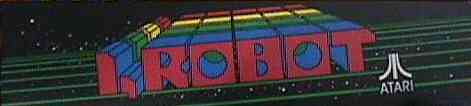
Description
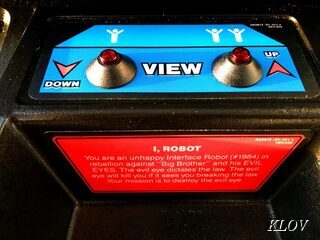
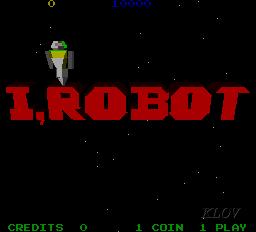
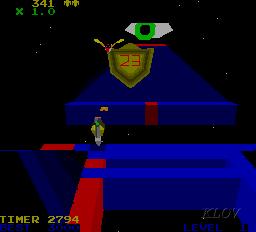
The first videogame using 3-D filled polygons. I, Robot placed the player in a at the time bewildering landscape of surrealistic shapes and sounds. Using a Hall-effect joystick, two fire buttons and two buttons to control the players viewing angle, the player controls "Unhappy Interface Robot 1984" as he tries to clear each cleverly designed level of red tiled polygons.
I, Robot was produced by Atari in 1983.
Atari released 136 machines in our database under this trade name, starting in 1972. Atari was based in United States.
Other machines made by Atari during the time period I, Robot was produced include: Fast Freddie, Gravitar, Dig Dug, Black Widow, Akka Arrh, Alpha 1, Arabian, Cloak & Dagger, Cloud 9, and Crystal Castles
Specs
| Name | I, Robot |
|---|---|
| Developer | Atari (United States) |
| Year | 1983 |
| Type | Videogame |
| KLOV/MOG # | 8172 |
| Class | Wide Release |
| Genre | Shooter |
| Development Team |
|
| Monitor |
|
| Conversion Class | unique |
| Game Specific | I, Robot Pinout |
| Dipswitch Settings | |
| # Simultaneous Players | 1 |
| # Maximum Players | 2 |
| Game Play | Alternating |
| Control Panel Layout | Single Player Ambidextrous |
| Controls |
|
| Sound | Amplified Stereo (two channel) |
| Cabinet Styles |
|
Game Introduction
Big Brother has said no jumping, but it is all poor robot1984 loves to do. He must travel through each maze-like level, eliminating the shield protecting Big Brother's watchfull eye and then destroy the eye itself. After each level, he gets to fly though space to the next level, where he begins his task anew.
Game Play
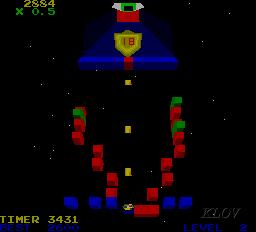
The game play consists of moving robot1984 over all of the red tiles while avoiding objects flying at you from the back of the screen. Eliminating the red tiles diminishes the shield at the back of the playfield which prevents you from flying to the next level. To get to all the red tiles, players sometimes need to leap across empty space which creates a permanent bridge between the two points. Leaps across empty space have to be timed so that the "eye" of Big Brother in the back of the playfield, which randomly opens and closes, does not see robot1984 and destroy him.
When all of the playfield's red tiles have been eliminated, the shield disapears and the player can then leap to the final red tile on the level which destroys the "eye" and ends the level. The victorious robot then jumps off the playfield and flys through space to the next puzzle-like playfield.
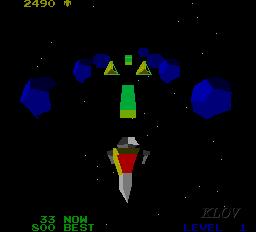
While flying through space, the player needs to avoid polygon obstacles while blasting stars. Every five levels, the space flight sequence is replaced with a flight through space ending with a large "head." The head, when faced, shoots spikes at the player in the real world - not robot1984. All the spikes need to be shot while in front of the robot or they will circle behind and destroy him.
The playfields are not randomly generated. However, they always vary from level to level. A unique feature of the game, which greatly aids game play on some levels, is the ability to change one's perspective of the playfield at anytime by moving the "camera" viewpoint through a certain range of possible locations. The camera viewpoint always remains behind robot1984.
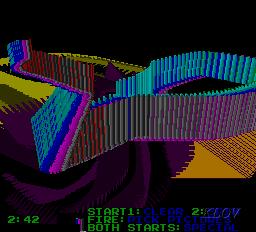
An interesting option called "Doodle City" allows the player to spend a few minutes drawing and experimenting with the game's polygon objects. Drawing objects can also be animated, spining or orbiting on one of their axis. Players chosing to spend time in "Doodle City" can switch to the game with a diminished number of lives based on how long they spend doodling.
I, Robot KLOV/IAM 5 Point User Score: 3.57 (8 votes)
Fun Factor: 3.33
Overall Like |
3.25 |
|---|---|
| Fun (Social) | 2.86 |
| Fun (Solo) | 3.25 |
| Collector Desire | 4.71 |
Technical Rating: 3.75
| Gameplay | 3.25 |
|---|---|
| Graphics | 4.00 |
| Originality | 4.63 |
| Sound/Music | 3.13 |
Personal Impressions and Technical Impressions each account for half of the total score.
Within the Personal Impressions category, Like
carries a little more weight than the other factors.
Log in to rate this game!
More pictures
Trivia
I, Robot was, apparently, originally to be called "Ice Castles". The game was a complete flop at the time, players were really unable to cope with the surrealism and "newness" of the graphics.
Although probably not the entire reason why the hall-effect joystick was not copied by other manufacturers, Atari was granted a patent now expired for a "finger control joystick utilizing Hall effect", which can be viewed at http://www.patents.ibm.com/details?pnUS04459578__s_clms1
Cabinet Information
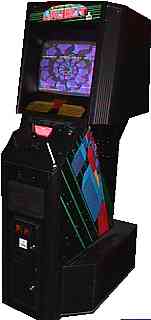
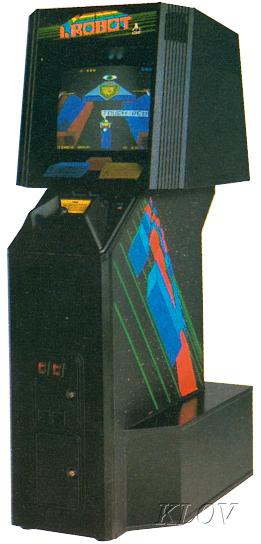
I, Robot's cabinet was identical to the Firefox upright, and similar to the Major Havoc dedicated. It featured a narrow "waist" area, a small control panel and an angled "top box" that held the monitor and seemed to be almost "winged" by the vertical speaker grills that flanked the sides of the monitor. The base flared out about 6 to 9 inches from the floor I could measure it if you want to form a sturdy base that angled in to a smaller flat front. The cabinet only had artwork around the "waist area" and control panel.
Miscellaneous
The game has 99 different playfields with 99 different space sequences between them. Completing certain levels allows the player to jump to higher levels, thus bypassing intermediate playfields. Legend has it that only 1000 were produced. Atari was only able to sell 500 in the US so the rest were shipped to Japan. If this is true, the serial numbers must not be sequential. A production run of 1200 to 1500 is probably more likely.
VAPS Arcade/Coin-Op I, Robot Census
There are 14,774 members of the Video Arcade Preservation Society / Vintage Arcade Preservation Society, 9,483 whom participate in our arcade census project of games owned, wanted, or for sale. Census data currently includes 164,626 machines (6,906 unique titles).
Very Common - There are 79 known instances of this machine owned by I, Robot collectors who are active members. Of these, 69 of them are original dedicated machines. One is a conversion in which game circuit boards (and possibly cabinet graphics) have been placed in (and on) another game cabinet. 9 of them are only circuit boards which a collector could put into a generic case if desired.
For Sale - There are 4 active VAPS members with a I, Robot machines for sale. There is one active VAPS member with an extra I, Robot circuit board for sale.
Wanted - Popular - There are 18 active VAPS members currently looking for I, Robot.
This game ranks a 20 on a scale out of 100 (100 = most often seen, 1=least common) in popularity based on census ownership records.
This game ranks a 25 on a scale out of 100 (100 = most often seen, 1=least common) in popularity based on census want list records.
Rarity and Popularity independently are not necessarily indications of value. [More Information]
Flyers

 1984
/ 4 Pages
1984
/ 4 Pages
Technical
The game uses a 6809 microprocessor and four Atari Pokey sound chips.
Manuals
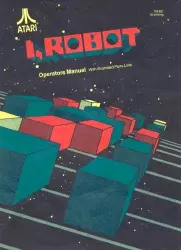
Foto-Finder® (Books)
- The Encyclopedia of Arcade Video Games Kurtz (ISBN 0764319256) Page: 181; Color photo Price guide: No
Additional References (logged in members often see more)
eBay Listings
Click to search eBay for I, Robot Videogame machines and related items.
Click to search eBay for Atari for machines and parts.
When you click on links below to various merchants on this site and make a purchase, this can result in this site earning a commission. Such revenue helps to fund this site's operations. Affiliate programs and affiliations include, but are not limited to, the eBay Partner Network.
TOP WATCHED LISTINGS FOR: I, Robot


I, Robot (I-Robot/iRobot) Arcade Marquee/Sign (26" x 8")
Auction ends in: 1 week, 1 day

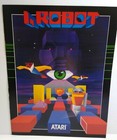
I Robot Arcade FLYER Original 1984 UNUSED Retro Space Age Video Game Brochure
Auction ends in: 1 week, 2 days

ATARI I, ROBOT Upright Back Door Sheet New Atari Part ST-251 1st Printing
Auction ends in: 2 weeks, 5 days

QUAD POKEY ELIMINATOR for Major Havoc Return of the Jedi Firefox I,Robot
Auction ends in: 1 week, 22 hours

Irobot Atari Arcade Marquee For Reproduction Header/Backlit Sign
Auction ends in: 1 week, 2 days

I Robot control panel decals silkscreened and die cut 2 sets
Auction ends in: 3 weeks, 3 days
Contribute
- Log in to contribute content to this page
- Please consider donating to the International Arcade Museum Library