
Tempest
![Tempest - Japanese Logo - Katakana / Kanji]()

Description
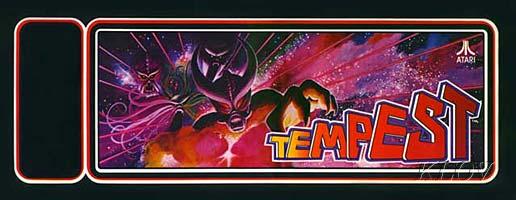
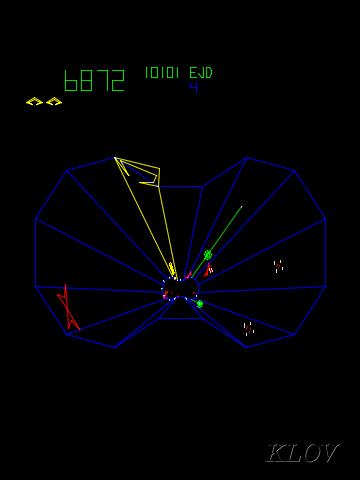
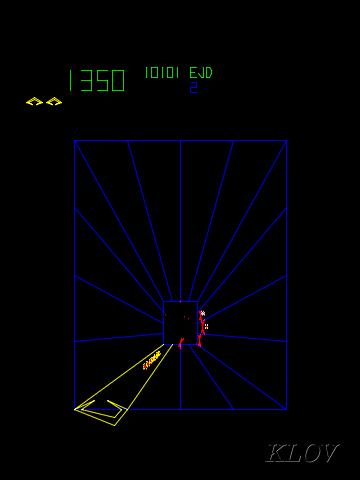
You control a yellow crab-shaped shooter that travels along the outside rim of a 3-dimensional tunnel, shooting enemies down the alleys of the tunnel while avoiding any coming down the alleys. The tunnel takes on many different forms, and the shooter has a special "superzapper" that enables it to kill all enemies present in the tunnel.
Tempest was produced by Atari in 1981.
Atari released 136 machines in our database under this trade name, starting in 1972. Atari was based in United States.
Other machines made by Atari during the time period Tempest was produced include: Battlezone, Centipede, Turtleroids, Missile Command, Asteroids Deluxe, Triangle, Tempest Tubes, Maze Invaders, Neutron Star, and Fast Freddie
Specs
| Name | Tempest |
|---|---|
| Developer | Atari (United States) |
| Year | 1981 |
| Type | Videogame |
| KLOV/MOG # | 10065 |
| Class | Wide Release |
| Genre | Space |
| Development Team |
|
| Monitor |
|
| Conversion Class | unique |
| Game Specific | Tempest Pinout |
| Dipswitch Settings | |
| # Simultaneous Players | 1 |
| # Maximum Players | 2 |
| Game Play | Alternating |
| Control Panel Layout | Single Player |
| Controls |
|
| Sound | Unamplified Mono (requires one-channel amp) |
| Cabinet Styles |
|
| Instructions | Tempest Instructions Image |
| Control Panel | Tempest Control Panel Image |
| Side Art | Tempest Side Art Image |
| PCB | Tempest PCB Image |





Game Introduction
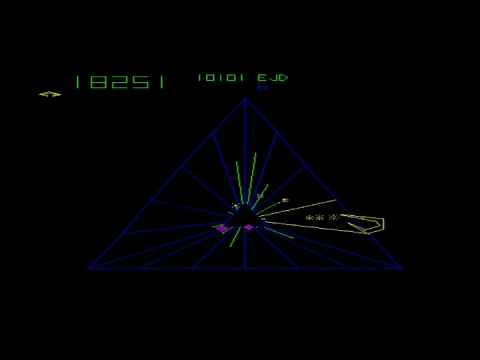
You are given a vanishing-point perspective from the top, looking down into a geometric shape. The shapes vary from a line, to a triangle, to a circle, to more complex shapes. Enemies enter from the bottom and work their way up towards the top. Collision with an enemy or an enemy's shot is fatal.
A level is cleared when all the enemies have been destroyed, or the only enemies left are the red shooters that have reached the top of the tunnel. When proceeding to the next level, shoot and destroy, or avoid, the green spikes that are left over, as a collision with them is fatal.
The superzapper will destroy all the enemies on screen the first time it is used. The second time has a much more limited effect. The superzapper will not work a third time. However, the superzapper recharges itself at the start of each new level. The final levels of the game are the green, which begin at level 81, and repeat thereafter with no increase in difficulty.
Tempest KLOV/IAM 5 Point User Score: 4.47 (38 votes)
Fun Factor: 4.39
Overall Like |
4.55 |
|---|---|
| Fun (Social) | 3.66 |
| Fun (Solo) | 4.47 |
| Collector Desire | 4.37 |
Technical Rating: 4.55
| Gameplay | 4.63 |
|---|---|
| Graphics | 4.74 |
| Originality | 4.76 |
| Sound/Music | 4.08 |
Personal Impressions and Technical Impressions each account for half of the total score.
Within the Personal Impressions category, Like
carries a little more weight than the other factors.
Log in to rate this game!
Cheats, Tricks, Bugs, and Easter Eggs
TRICK: On a level that is not a fully enclosed shape, you can often sit at one of the far ends, and when an approaching enemy is right next to you, hold down your fire button, and they will be destroyed.
TRICK: Get a score in the form of XXYYZZ, where XX > 16, 29 < YY < 60, and ZZ is a code. Some codes are:
- 01 - Test mode.
- 06, 11, 12 - 40 free games.
- 46 - Start at any level you like up to level 81.
In the test mode, you can zero the high score table and examine the game parameters, but not modify them.
BUG: Scores beyond 999999 are not possible, as the score will roll-over to 000000.
More pictures


Trivia
According to a video clip off of the Playstation "Arcade's Greatest Hits: Atari Collection 1" a compilation of Atari's arcade titles from the early 80's, the original idea for Tempest came to Dave Theurer in a nightmare about creatures or monsters crawling up from a hole in the ground.
Originally called Vortex in the prototype stages, this was Atari's first color vector game. Supposedly, the original creators were trying to develop a 3-D monster game. They were not very happy with the finished product since they wanted even better graphics but were unable to achieve their goal with the technology at the time.
The fact you can earn 40 free games with a certain score was the fault of developer Dave Theurer himself. He had created a special security code to protect against piracy which checked the placement of different objects. If the objects were not in the correct place, the game would shut down. Before the game was shipped, however, Theurer, who would fuss over minute details, noticed an Atari logo was off-center. He adjusted it slightly. This small change caused the code to malfunction and the player to earn 40 free credits if a certain score was reached.
The game can be seen being played at the end of the Rush music video for Subdivisions.
Cabinet Information
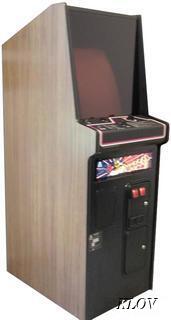
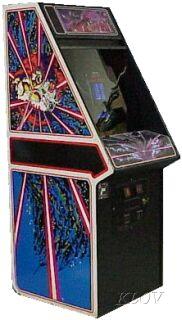
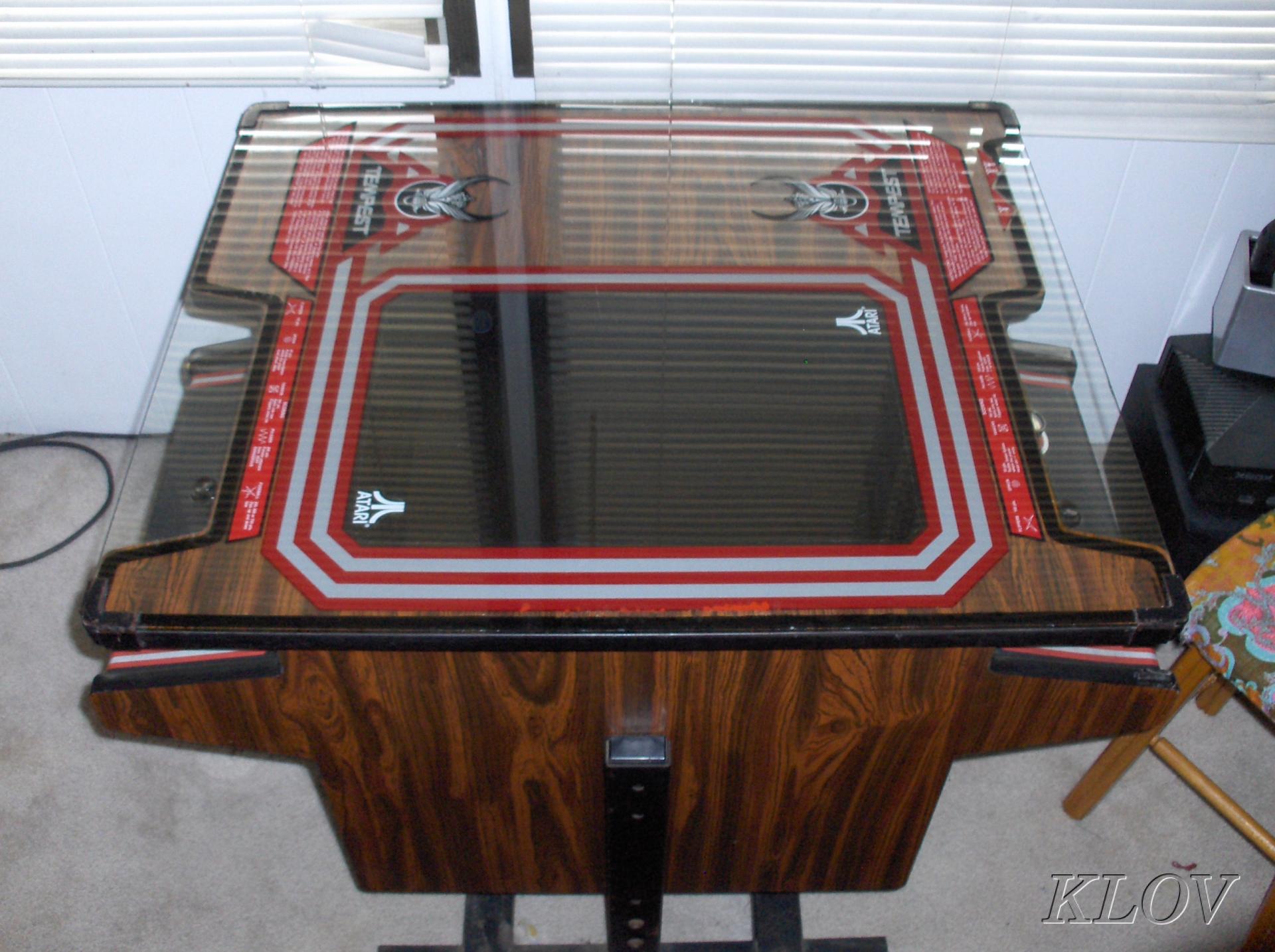
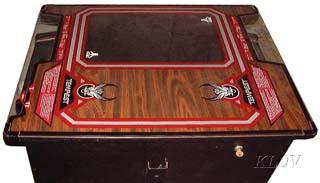
The game is well known for its unusual triangular-shaped cabinet that is very pleasing to the eye. A less attractive cabaret and cocktail model were also produced.
Conversion
There was a Major Havoc conversion kit made for Tempest machines that included its own unique control panel, sideart, decals and marquee.
Tempest Tubes is a ROM upgrade created by a hobbiest that contains totally different and more difficult tube shapes. It is available at http://www.gamearchive.com/video/manufacturer/atari/vector/roms/tempest_tubes.zip
Clay Cowgill produces a Tempest Multigame kit that includes the Vortex and Aliens Vector prototype, and a new game called Vector Breakout. It is available at http://www.multigame.com/tempest.html
Miscellaneous
This game was chosen as the first arcade game to have its source code openly documented by enthusiasts of the game. The Tempest Code Project has detailed information about the game. It was coded in 6502 assembly language.
The prototypes for this game were called Aliens Vector and Vortex.
Tempest is available on the iPad and iPhone via Atari's Greatest Hits application.
VAPS Arcade/Coin-Op Tempest Census
There are 14,748 members of the Video Arcade Preservation Society / Vintage Arcade Preservation Society, 9,472 whom participate in our arcade census project of games owned, wanted, or for sale. Census data currently includes 164,454 machines (6,894 unique titles).
Very Common - There are 1,211 known instances of this machine owned by Tempest collectors who are active members. Of these, 1,149 of them are original dedicated machines. 8 of them are conversions in which game circuit boards (and possibly cabinet graphics) have been placed in (and on) another game cabinet. 50 of them are only circuit boards which a collector could put into a generic case if desired.
For Sale - There are 38 active VAPS members with a Tempest machines for sale. There are 4 active VAPS members with a Tempest circuit boards for sale.
Wanted - Very Popular - There are 121 active VAPS members currently looking for Tempest.
This game ranks a 97 on a scale out of 100 (100 = most often seen, 1=least common) in popularity based on census ownership records.
This game ranks a 100 on a scale out of 100 (100 = most often seen, 1=least common) in popularity based on census want list records.
Rarity and Popularity independently are not necessarily indications of value. [More Information]
Flyers

 1982
/ 2 Pages
1982
/ 2 Pages


 1981
/ 2 Pages
1981
/ 2 Pages


Technical
The game is generally known for its monitor problems. An excellent vector monitor fix-it guide has been written by Gregg Woodcock and is available at http://links.magenta.com/havoc/atari/vector/html/vector.html
Another very excellent tutorial for monitor issues is located at http://plop.phys.cwru.edu/repairfaq/REPAIR/whole/F_VAtari.htmlVATARI_031
The game's sound is generated by two Atari Pokey ICs which provide a total of eight voices. The Pokeys handle various other tasks, such as interpreting the spinner. The video is handled by the Atari Vector Generator which has its own RAM and ROM. The main program ROM is 20k. The processor is a 6502 running at 1.5mhz. Overall, the hardware is loosely based on Atari's line of 8-bit home computers. The spinner is actually a digital input device with four bits of resolution.
Clay Cowgill has conditionally committed to creating a cartridge-based system for this platform. http://arcade.gameshop.com/tempest-hw/cart.txt
Fixes
The main problem with Tempest is monitor failures, as the attract screen produces a lot of stress on the low-voltage section of the deflection chassis. A low-voltage upgrade (LV2000 or LV6100) can be purchased from online vendors to correct this issue. A non-tech fix is to decrease the picture size using the pots on the game PCB. This will produce a smaller picture that causes less stress on the monitor.
Manuals


Foto-Finder® (Books)
- The Encyclopedia of Arcade Video Games Kurtz (ISBN 0764319256) Page: 107; Color photo Price guide: No
- Arcade Fever Sellers (ISBN 0762409371) Page: 84; Color photo
- Encyclopedia of Arcade Video Games Kurtz (ISBN 0764319256) Page: 107; Color photo
Additional References (logged in members often see more)
See the game at:
This game is available at the following public arcades, bars or museums:
| Name | Location | State | Country | Details | Check-ins |
|---|---|---|---|---|---|
| Level One Bar + Arcade | 130 Hutchinson Ave, Columbus | Ohio | United States | 0 |
eBay Listings
Click to search eBay for Tempest Videogame machines and related items.
Click to search eBay for Atari for machines and parts.
When you click on links below to various merchants on this site and make a purchase, this can result in this site earning a commission. Such revenue helps to fund this site's operations. Affiliate programs and affiliations include, but are not limited to, the eBay Partner Network.
TOP WATCHED LISTINGS FOR: Tempest



Tempest ARCADE Video GAME PCB 2 BOARD set untested
Auction ends in: 8 hours, 48 minutes

Atari Tempest Cocktail Game TOP ONLY Vintage ORIGINAL Arcade Machine 1981
Auction ends in: 2 weeks, 1 day

Tempest | Tempest Tubes Multigame High Score Save and Free Play Kit - Arcade
Auction ends in: 2 weeks, 3 days

Tempest Operations, Maintenance and Service Manual For Arcade Board
Auction ends in: 4 weeks, 1 day

Tempest Video Arcade Game PCB Working UPGRADED Tubes BULLETPROOF Atari FREE SHIP
Auction ends in: 1 day, 14 hours

Tempest original Arcade1Up LED marquee for 12V power with mounting screws
Auction ends in: 1 week, 6 days

VINATAGE Untested Tempest Aux Only Atari ARCADE Video GAME PCB BOARD Ofae-11
Auction ends in: 1 week, 4 days

Tempest Coin-op Arcade power supply board repair and refurbish service
Auction ends in: 1 week, 3 days
Auction Results
Logged in members can see all related auctions.
Auctions Recap
| Year | Count | Median $ | Average $ |
|---|---|---|---|
| 2015 | 1 | 517.50 | 517.50 |
| 2016 | 6 | 747.50 | 785.83 |
| 2017 | 5 | 708.00 | 682.10 |
| 2018 | 10 | 1,150.50 | 1,274.40 |
| 2019 | 6 | 1,298.00 | 1,366.83 |
| 2020 | 2 | 1,629.50 | 1,629.50 |
| 2021 | 7 | 3,105.00 | 3,330.14 |
| 2022 | 10 | 1,840.00 | 1,943.50 |
| All Years | 47 | 1,265.00 | 1,608.36 |
Contribute
- Log in to contribute content to this page
- Please consider donating to the International Arcade Museum Library