
Puppy Pong
![Puppy Pong - Japanese Logo - Katakana / Kanji]()


Description
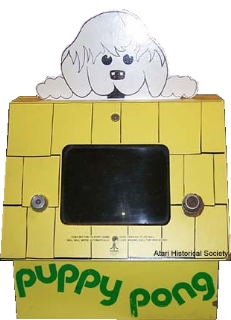
This is the original game packaged in a cute yellow dog house.
Before building Puppy Pong, Atari built a prototype 'Snoopy Pong' game. Animator Charles Schultz threatened a lawsuit, and only one Snoopy Pong was developed.
In or about August of 1974, Snoopy Pong was redesigned with a generic puppy that didn't look like the famous Snoopy cartoon character. The game made its big debut at Chuck E. Cheese's restaurants aka Pizza Time Theatre in Sunnyvale, California. It is relevant to note that Chuck E. Cheese was founded by Nolan Bushnell, who also founded Atari.
It is a table top game, and as a 'free play' machine does not contain a coin mechanism.
The best estimates of the collecting community are that somewhere between 35 and 100 Puppy Pong machines were built. While we don't know how many have survived, we have run into several different collectors that incorrectly believe they have the only one.
Legend has it that even after the game was changed to Puppy Pong, Shultz the creator of Peanuts still complained about the similarity of the cartoon and game and asked them not to make any more of them. As a result, the game never went into wide production.
Puppy Pong was produced by Atari in 1974.
Atari released 136 machines in our database under this trade name, starting in 1972. Atari was based in United States.
Other machines made by Atari during the time period Puppy Pong was produced include: Doctor Pong, Gotcha, Coupe Davis (Pong Doubles), Pong Doubles, Snoopy Pong, Pursuit, Gran Trak 20, Pin Pong, Quadrapong, and Gran Trak 10
Specs
| Name | Puppy Pong |
|---|---|
| Developer | Atari (United States) |
| Year | 1974 |
| Type | Videogame |
| KLOV/MOG # | 9159 |
| Class | Prototype |
| Genre | Ball and Paddle |
| Conversion Class | unique |
| # Simultaneous Players | 2 |
| # Maximum Players | 2 |
| Game Play | Competitive |
| Control Panel Layout | Multiple Player |
| Controls |
|
| Sound | Amplified Mono (one channel) |
| Cabinet Styles |
|
Game Introduction
The object is to keep the ball in play and hope your opponent misses.
Game Play
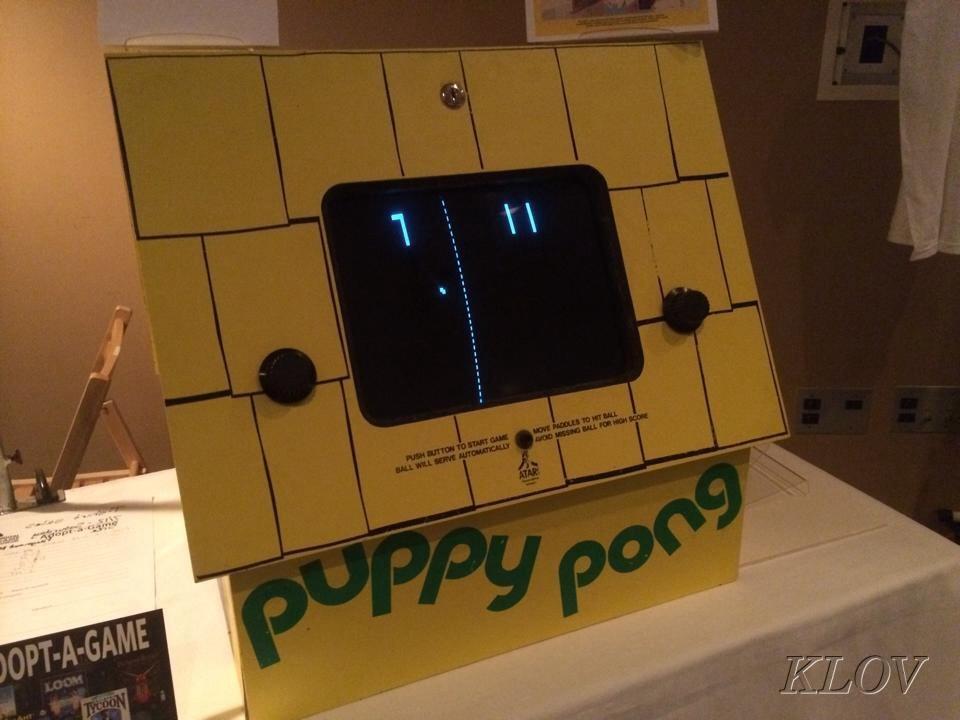
A ball is launched onto the playing field. Using a flat paddle, you deflect the ball towards your opponent. Your opponent also with a flat paddle, does the same. Points are scored when the opposing player missed and the ball gets past him/her. The first player to ten points, wins.
Puppy Pong KLOV/IAM 5 Point User Score: 0.00 (0 votes)
Personal Impressions and Technical Impressions each account for half of the total score.
Within the Personal Impressions category, Like
carries a little more weight than the other factors.
Log in to rate this game!
More pictures
Trivia
The following text is found at httpwww.atarihistory.comarcadepuppypong.html BLOCKQUOTEThis is a very rare and rather unknown Atari coinop game. Basically it was Atari Pong without a coin box packaged into a very cute little table top wooden cabinet. According to Regan Cheng formerly of Ataris Industrial Design group Regan is the man responsible for the ominous Atari 5200 look and he also created Ataris all new hightech XL computer line styling. The Puppy Pong was originally conceptualized by Nolan Bushnell, Steve Bristow, and various marketing guys. The original idea was Snoopy Pong for which I designed a red dog house cabinet with Snoopy on top as you see in the comics. The original concept was called Doctor Pong, a unit for pediatrician office waiting rooms to keep children occupied. Regan also mentioned It was originally designed by Chas Grossman, Industrial Designer. He was the design manager for Pete Tachaichi and myself I believe for about 1 year 1975. The puppy house was left over from the Snoopy Pong, but painted yellow instead of red. It was the perfect game for small children and so simple to play all it took was a push of the button located in the center of the game under the main screen that would reset the game to play up to a winning 10 point score. The reason very few people have ever heard of this version of Pong in a Dog House cabinet is that the dog house had a similar look to another more famous dog house belonging to a rather popular beagle from the 70s.... Snoopy, according to Dennis Gregory who was the original owner of this Puppy Pong, apparently Schulz contacted Atari and requested that Atari not produce a game that too closely resembled his Snoopy Dog House So Ataris Puppy Pongs only spotlight in public was during its testing phase in the Chuck E. Cheese Pizza Time Theater in California where it was placed on table tops in the restaurant for people to play while waiting for their pizza. This Puppy Pong has made its way to the Atari Historical Society courtesy of Dennis Gregory a former Atari employee and former Pizza Time employee.BLOCKQUOTE
Cabinet Information
The game is housed in a table top yellow dog house with Puppy Pong labeled along the bottom. A puppys head and paws stick out of the top. There is no coin slot since the player simply pushes the start button to begin a game.
Miscellaneous
Was only tested in Chuck E. Cheeses Pizza Time Theatres in California.
VAPS Arcade/Coin-Op Puppy Pong Census
There are 14,754 members of the Video Arcade Preservation Society / Vintage Arcade Preservation Society, 9,475 whom participate in our arcade census project of games owned, wanted, or for sale. Census data currently includes 164,460 machines (6,896 unique titles).
Scarce - There are 4 known instances of this machine owned by Puppy Pong collectors who are active members. Of these, 4 of them are original dedicated machines.
Wanted - There is one active VAPS member currently looking for Puppy Pong.
This game ranks a 1 on a scale out of 100 (100 = most often seen, 1=least common) in popularity based on census ownership records.
This game ranks a 2 on a scale out of 100 (100 = most often seen, 1=least common) in popularity based on census want list records.
Rarity and Popularity independently are not necessarily indications of value. [More Information]
Flyers

 1974
/ 4 Pages
1974
/ 4 Pages

Legacy
eBay Listings
Click to search eBay for Puppy Pong Videogame machines and related items.
Click to search eBay for Atari for machines and parts.
When you click on links below to various merchants on this site and make a purchase, this can result in this site earning a commission. Such revenue helps to fund this site's operations. Affiliate programs and affiliations include, but are not limited to, the eBay Partner Network.
Contribute
- Log in to contribute content to this page
- Please consider donating to the International Arcade Museum Library